The Overlocker You Only Need Twice a Year: Inside Camden's Borrow-Don't-Buy Boom
It is a Tuesday evening in a church hall a few streets back from Kentish Town Road, and the queue at the folding table is not for tea. It is for an overlocker. Behind the table a volunteer works down a laminated list, lifts a squat grey machine out of a padded bag and runs through the speech she has given forty times this month: keep the blade guard on, don't force the tension dials, bring it back a week on Saturday.
The woman collecting it is Roisin, who has been sewing for two years — tote bags, hemming, the odd cushion — and who has wanted an overlocker since the first time she watched one in action. 'They're three hundred quid minimum and I've got nowhere to put one,' she says. 'My flat is a kitchen with a bed attached.' For the next fortnight she has one anyway, for the price of an annual membership that costs less than a decent pair of dressmaking shears.
This is the quietest revolution in North London's craft scene. Nobody is marching about it. There is no campaign, no hashtag, no ribbon-cutting photo op. There are just shelves — in halls, in libraries, in shared studios — loaded with the things hobbyists need twice a year and cannot justify owning once.
The shelf your toolkit ought to be on
Call them tool libraries, libraries of things, loan sheds, kit collectives. The names vary by postcode; the principle doesn't. You pay a small membership, you borrow an object for a week or two, you bring it back. Someone else's project starts the day yours ends.
The Camden network has grown unevenly, which is exactly how these things tend to grow. A borrowed gazebo here, a donated bandsaw there, a retired dressmaker's entire collection of presser feet catalogued by two volunteers on a wet Sunday. One scheme operating out of a hall near Chalk Farm now lends more sewing machines than it owns shelves for. Another, run by a handful of members from a studio building in Gospel Oak, treats its small press and its etching blankets as a shared resource with a booking spreadsheet and a WhatsApp group that gets heated about felt.
What unites them is a stubborn refusal to accept that a hobby should come with a storage unit.
What's actually on the shelves
More than you'd guess, and less than you'd hope. Stock is donated, so it follows the enthusiasms of whoever cleared out a garage that month.
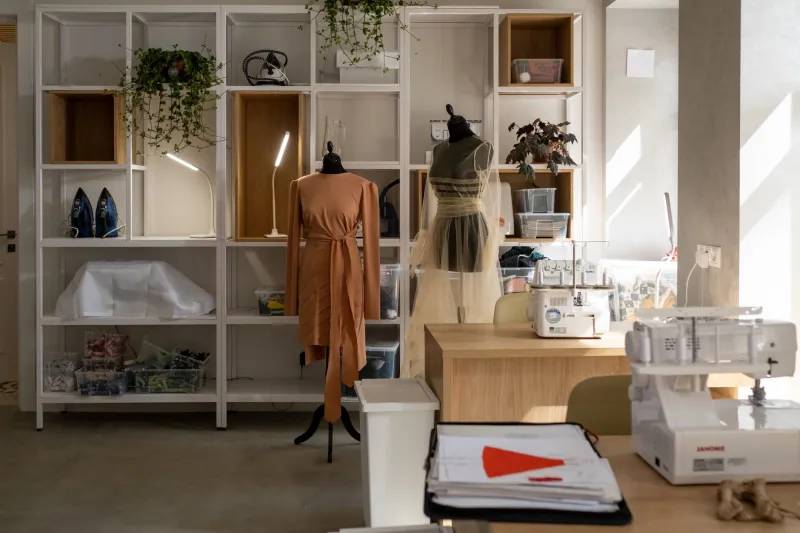
- Sewing and textiles: machines, overlockers, a dress form or two, pinking shears, cutting mats, a knitting machine that nobody has quite mastered but everybody wants to try.
- Woodwork: jigsaws, random orbital sanders, a mitre saw that comes with a mandatory induction, clamps beyond counting.
- Print and paper: a small relief press, brayers, a guillotine, screens for screenprinting, a light box for cyanotypes.
- The gloriously random: cake tins, a projector, folding tables, a badge maker, three different kinds of glue gun and one very good staple gun.
Don't expect a lathe. Do expect to be asked, politely, whether you've used one of these before.
'I stopped buying things I use twice a year'
Marcus, a set designer who lives off Queen's Crescent, worked out that he had spent roughly £600 over four years on tools he had used fewer than ten times each. 'The nail gun was the moment,' he says. 'I used it for one weekend and then it sat in a cupboard annoying me.' He now borrows, and has redirected the money into materials. 'Better plywood. Glue that actually works. That's the trade.'
Priya, a printmaker in Somers Town, borrows a press rather than buying one for a reason that has nothing to do with money. 'A press is a lump of cast iron. It needs a floor that can take it and a room that isn't your bedroom.' She books it for two evenings a month, works flat out, and goes home. 'I make less work. I finish more of it.'
The pattern repeats across every maker I speak to: borrowing narrows the gap between wanting to make something and actually making it. No saving up. No clearing a weekend to drive to a retail park. No convincing yourself you'll use it more than you will.
The one-bedroom argument
There's a sustainability case here about embodied carbon and landfill and the sheer waste of a million second-hand sewing machines in lofts across the country. All of that is true. But the honest reason tool libraries work in Camden is floor space.
When your entire making life has to fit on a folding table by a window, ownership is a tax on the room you live in. A shared overlocker is not a compromise; it's the sensible response to living in a flat where the hoover lives in the hallway. Access-over-ownership isn't an ideology for most people. It's a spatial solution that happens to be greener.
How to join without a fuss
Schemes differ, so check before you turn up with a bag of fabric, but the shape is broadly the same:
- Proof of address. Most ask for a Camden postcode; a few welcome anyone with an N or NW postcode, and some don't ask at all.
- Membership fee. Typically £10–£30 a year, with concessions. Several are free and run on volunteering instead.
- A short induction. Ten minutes for a sewing machine, longer for anything with a blade that spins.
- A deposit or a signature. Usually modest, refundable, and waived for members who've borrowed before.
- A return date. Respect it. The whole thing collapses if one person's 'next week' becomes next month.
Ask, too, what happens when something breaks. The good schemes fix it and thank you for telling them. The great ones run a monthly repair evening where the fixing is the point.
The catch nobody advertises
Libraries don't run themselves, and the ones that last are the ones with a rota, an insurance policy and someone willing to spend their Saturday counting bobbins. Several rely on members volunteering a few hours a term. If you borrow, consider it part of the deal — turn up to the stocktake, mend a cable, teach a beginner to thread a machine.
The other catch is expectation. A borrowed sander will not be the sander you'd have chosen. It may be heavier, older, missing a dust bag. You'll learn to work with it. Honestly, that's not a bad lesson for anyone who makes things.
Why access is winning
For decades the hobbyist's path was clear: want a thing, buy the thing, discover you didn't need the thing, keep the thing. What's emerging now is a gentler, thriftier model where the neighbourhood holds the kit and you hold the library card. It makes entry cheaper, keeps materials money in the local economy and turns strangers into people who will lend you a clamp.
Roisin will bring the overlocker back on the 21st. She'll finish two dresses, curse the tension dials once, and hand it over to whoever's next on the list. Then she'll go back to her kitchen with the bed attached, and her cupboards will still close.