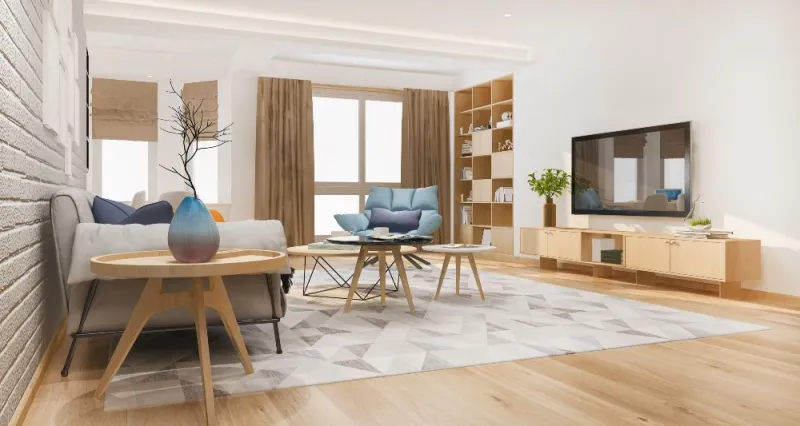
The Folding Table Studio: Crafting in a Camden Flat Without Losing the Plot
Photo: Mike Kirby, CC BY-SA 2.0, via Wikimedia Commons
Camden flats are not famous for their spare rooms. Victorian conversions with awkward corners, ex-council blocks with generous windows, and newer builds where the storage is more optimistic than actual. Yet makers keep making. They sew on folding tables, store fabric under beds and turn balconies into miniature studios. The trick is not finding more space. It is using the space you have with a bit of cunning.
Start with the room you actually have
Lena sews on a folding table in the corner of a one-bed off Prince of Wales Road. When she finishes, the table goes behind the sofa and the machine goes into a cupboard. 'It takes two minutes to set up and two minutes to put away,' she says. 'The two minutes are the whole system.'
Tom carves spoons on a balcony in Gospel Oak. He has a small foldable bench, a weatherproof box for tools and a rule: nothing comes inside that cannot be carried in one trip. 'The balcony is my studio in summer and my drying rack in winter,' he says.
Aisha shares a flat near Camden Square and stores her fabric in under-bed boxes on wheels. 'I have a map of what is where,' she says. 'Without the map, I buy the same blue linen three times.'
Storage that works with a Camden flat
Vertical space is your friend. The inside of a cupboard door can take a pegboard for scissors, rulers and small tools. A wall above a desk can hold shelves or a magnetic strip. Over-door organisers, usually sold for shoes, work for ribbons, brushes and rolls of paper.
Clear boxes are better than pretty ones. You need to see what you have. Label them with a marker, not a label maker you will never refill. Under-bed storage is the classic for a reason: it is out of the way and easy to ignore. Use it for materials, not for projects you are actively working on.
Charity shops in Kentish Town and Kilburn are good for mismatched storage tins and baskets. You do not need a matching system. You need a system that survives a busy week. And if you live in a shared flat, talk to your flatmates about boundaries. A labelled shelf in the hallway is better than a passive-aggressive note about glitter.
Furniture that does two jobs
A folding table is the workhorse of the small-space maker. Look for one with a decent weight limit and a lockable hinge. A drop-leaf table can be a desk, a dining table and a cutting table. A trolley can hold supplies and then roll into a corner. A stool with storage inside is useful if you have somewhere to put it.
Lena uses a second-hand sewing table that folds down. 'It was twenty quid from a Facebook group,' she says. 'It is not beautiful, but it works.' Tom's balcony bench doubles as a seat and a workbench. Aisha uses a stack of sturdy boxes as a bedside table and a cutting surface. None of this is glamorous. All of it is practical.
The balcony studio
Balconies are underrated. They are not weatherproof, and they are not warm, but they can be a place to make mess. A foldable bench, a weatherproof storage box, a clamp for a vice, and a rule about noise and neighbours. Check your lease before you drill anything. Use a tray to catch shavings. Bring tools in at night.
In summer, a balcony can be a lovely place to work. In winter, it is a drying rack and a storage extension. The makers we spoke to treat it as a bonus room, not a permanent studio. That mindset helps. If the balcony is a bonus, you do not expect it to be perfect.
Containment (and why it matters)
A project that spreads across the flat can feel creative for a day and chaotic by Thursday. Containment is the answer. A tray for small parts. A basket for the current project. A mat that defines the work zone. When you stop for the day, everything goes on the tray or in the basket. The flat returns to being a flat.
Aisha has a 'one in, one out' rule for fabric. If she buys a new metre, something else leaves. It is not a punishment. It is a way to keep the under-bed boxes from becoming a mystery. Tom has a similar rule for wood offcuts. 'If it does not fit in the box, it goes to the community wood recycling project,' he says.
A five-minute reset
The most useful tool in a small-space craft practice is a five-minute reset. Set a timer. Put away the scissors. Sweep the floor. Wipe the table. Close the box. It is not about being tidy. It is about making it easy to start again tomorrow.
Lena says the reset is the difference between a hobby and a chore. 'If I leave it out, I dread it. If I put it away, I look forward to it.' That is the whole point. Your craft space should invite you back, not make you feel guilty every time you walk past it.
Small space, big making
You do not need a dedicated studio to make things in Camden. You need a bit of lateral thinking, a folding table, a few boxes and a willingness to adapt. The borough is full of makers doing exactly that. Some of them are in this article. Some of them are in your building. Ask them how they do it. Small-space craft is a community sport.