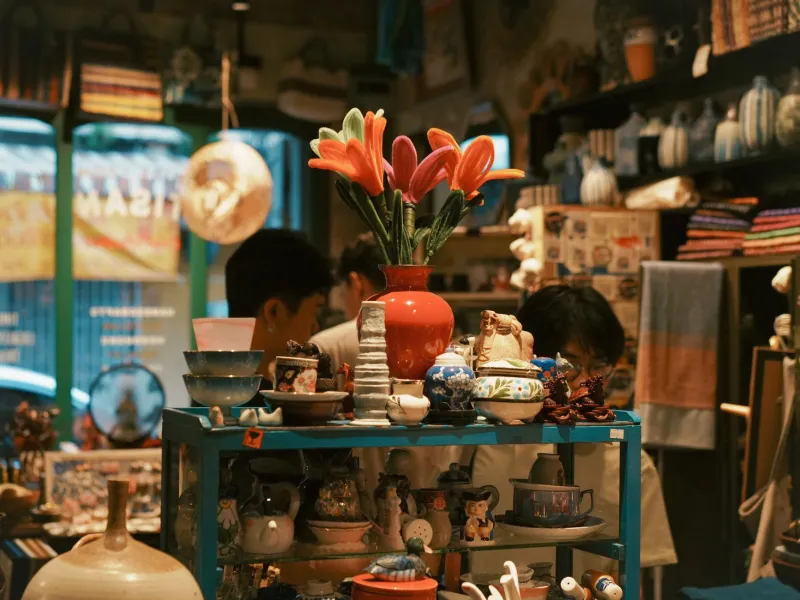
Daylight, a Tea Towel and Three Angles: Phone Photography That Sells Camden Handmade

There is a particular kind of Camden afternoon that smells of clay dust, coffee and the inside of a tote bag. You have spent three weeks making a run of mugs, or a stack of lino prints, or a small army of lavender bags. Now you need photographs. Not a brand campaign. Not a mood board. Just pictures that show the thing clearly enough that someone at a market in Kentish Town, or scrolling on their phone on the Overground, trusts what they are buying.
The good news: the camera you already own is fine. In 2026, phone cameras are more than capable of photographing handmade work well. The bad news: most of us make the same mistakes. We shoot at night under a yellow bulb, use a filter that turns stoneware into cheese, and then wonder why the real thing looks different in daylight.
The window is the studio
Forget the idea that you need a light tent, a tripod and a spare room. Start with a window. In a Camden flat, that might be the one that looks onto a bin store, or the sash window that rattles when a bus goes past. It does not matter what the view is. What matters is the light coming in.
Indirect daylight is your friend. A bright but overcast day is often better than blazing sun, because it wraps around objects instead of throwing hard shadows. If the sun is streaming in, tape a sheet of baking parchment to the glass as a diffuser. Clothes pegs are fine. So is a bit of tracing paper. Move your table two steps back from the window and watch the highlights soften.
Nadia, a ceramicist who works from a shared studio near Kentish Town, shoots on the same windowsill every Thursday. 'I use the morning light, a mug of tea and a stack of cereal boxes to prop up the phone,' she says. 'The boxes are not glamorous, but they do not move. That is the whole trick. Same spot, same time, same background.' She keeps a piece of grey card torn from an old sketchbook to check her whites. It is not a professional grey card. It does the job.
What Camden makers actually do
Priya, who sells block-printed textiles at Queen's Crescent market, used to photograph her work on hangers against a door. 'It looked like a lost-property cupboard,' she says. Now she folds each piece on a dark green blanket on the floor near the window. 'Texture reads better when it has something to sit against. And I stopped using the warm filter. Customers were buying rust-coloured napkins and receiving orange ones.'
Tom, who makes paper goods from a kitchen table in Chalk Farm, has a smart habit for colour accuracy. 'Paper is a nightmare,' he says. 'A pale cream looks white on one phone and yellow on another. I put a scrap of the same paper next to the item so the camera has a reference. Then I adjust the white balance until the scrap matches what I can see with my own eyes.'
None of them bought studio gear. That is the point. The kit is a window, a clean lens, a tea towel, a bit of card, some Blu Tack and a phone. Everything else is repetition.
A shot list you can keep in your notes app
Consistency comes from doing the same few shots well, not from buying a backdrop. Here is a simple starting point.
Ceramics: one straight-on front shot at eye level; one at 45 degrees; one top-down; one close detail of the glaze or handle; one in your hand for scale; one of the base or maker's mark. Tap to focus on the glaze, then drag the exposure slider down a touch so white clay does not blow out. Avoid direct sun on shiny glaze unless you want a hot white spot where the shape should be.
Textiles: one flat lay, folded neatly; one full-length shot hanging or draped; one close-up of the stitch, print or weave; one detail of the hem or fastening. If you are photographing a scarf or tea towel, include a familiar object for scale, such as a mug or a paperback. Keep the background quieter than the cloth. A patterned textile on a patterned sofa is a puzzle, not a product shot.
Paper goods: one straight-on shot of the cover or front; one angled shot showing thickness; one open or inside shot; one detail of the print, edge or binding. Use a sheet of plain paper underneath if the table is busy. For cards and prints, photograph them upright against a wall near the window rather than lying flat, so you do not get a shadow across the middle.
Edit like you mean it, not like you are hiding something
Snapseed and Lightroom Mobile are both fine. So is the built-in editor if you know what it is doing. The goal is not a look. The goal is accuracy with a bit of polish.
Crop and straighten first. Then adjust exposure, white balance and contrast. Lift the shadows a little if your shelf is dark. Do not push saturation until the clay looks radioactive. If you cannot tell whether the colour is right, take the object into daylight and hold it next to the photo on your screen. Your eyes are better than any preset.
Use one edit for a whole collection and save it as a preset. That is how you get a consistent visual style without making every mug look like it was dipped in the same Instagram filter. Keep the original file. If you sell online, add a photo that shows the item next to a ruler or a common object, and put dimensions in the caption. Honesty is not a design flaw. It is what stops returns.
Honest and inclusive by default
Photograph the work as it is. Show the speckles in the glaze and the slightly uneven hem. Those are the things people are buying. If you use hands in your photos, use a range of hands. Camden is not one skin tone, one age or one body. Ask friends, neighbours or fellow stallholders if you can photograph their hands holding your work, and credit them if they want to be credited.
Add alt text when you post online. Describe the object, the colour and the material. 'A tall stoneware mug in speckled oatmeal glaze with a pulled handle' is useful. 'Cosy vibes' is not. If someone cannot see the image, they should still know what you are selling.
The stall-side snap
At a market, shoot before the doors open. Use the quiet ten minutes when the light is still clean and the table is not yet covered in other people's bags. Find shade rather than sun. Ask the stall next door if you can borrow a plain cloth for thirty seconds. Shoot at eye level or slightly above, not from standing height looking down at a squashy table. Take one wide shot of the stall, one of your best three pieces, and one detail that sums up your making. Then put the phone away and sell.
Your stall is not a studio. Your window is. Your kitchen table is. The wall by the bin store is. The phone in your pocket is more than enough, as long as you give it daylight, a little patience and the truth.