The 12:30 Reset: Camden’s Lunch-Break Crafters on Crumbs, Clatter and Clocking Off

Photo: https://www.flickr.com/people/69061470@N05, CC BY-SA 3.0, via Wikimedia Commons
At 12:32 on a Tuesday, a meeting room off Kentish Town Road stops smelling of instant coffee and starts smelling of beeswax. Six people are threading needles, trimming felt and arguing gently about whether a French knot counts as showing off. By 1:05, the table is clear, the chairs are back and someone is wiping a glue stick down with a wet wipe. The afternoon stand-up starts at 1:15.
This is the lunch-hour craft club in its natural habitat: not a retreat, not a wellness brand, just a small, stubborn pocket of making wedged between spreadsheets. They have been multiplying across Camden in 2026 — in co-working spaces near King’s Cross, in the back rooms of Kentish Town cafés, in the sort of glassy office breakout areas that usually host birthday cake and awkward small talk. The appeal is obvious. You do not need a whole evening. You need forty minutes and something that fits in a sandwich tin.
Thirty Minutes Is the Whole Point
The first rule of lunchtime making is that the clock is not an obstacle. It is the format. Organisers talk about ‘desk-to-desk’ projects: things you can start, stop and shove in a bag without ruining. Think felt brooches, simple bookbinding, lino-cut stamps the size of a two-pence piece, visible mending on a coat cuff, or a row of crochet that does not mind being interrupted.
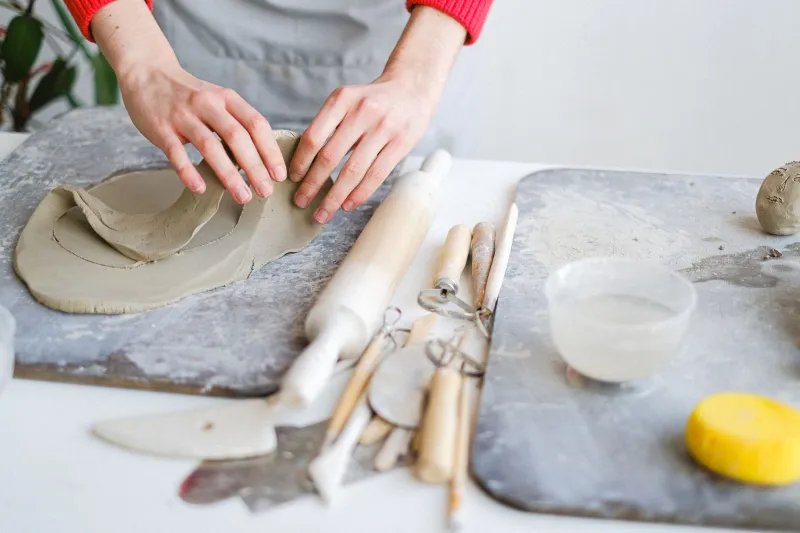
‘If it needs drying time, it is not a lunchtime project,’ says Maya, who runs a Tuesday club for a design studio near Granary Square. ‘We had one disastrous experiment with air-dry clay. Everyone spent the rest of the day with grey dust on their keyboard. Now we stick to wool, paper, thread and things that can go in a tin.’
The projects that survive are usually small in scale but not childish. A lunch hour is long enough to learn a single stitch, fold a proper pamphlet, or carve one rubber stamp. It is not long enough to glaze a bowl. That constraint has produced a distinct aesthetic: modest, repeatable, a bit scrappy. Some clubs run a three-week mini-series so people can finish something without pretending a single session is a complete journey.
The Kit That Earns Its Desk Space
Lunchtime crafters are ruthless about kit. The good ones carry a small pouch — not a whole studio — and they know exactly what weighs them down. A needle case, a tiny pair of scissors, a glue pen, a few metres of thread, one A6 sketchbook. Watercolourists use a pocket palette and a water brush. Knitters bring one ball of yarn and a project small enough to fit in a drawer.
Noise matters as much as size. Hammering is out. Loud sewing machines are out unless the room is genuinely separate. Crumbly materials are out. So is anything with a strong smell, which rules out some varnishes and most solvent-based glues. ‘We had a rule after the first month: if you would not do it on a train table, do not do it here,’ Maya says.
The etiquette extends to shared tables. Bring a cloth or a piece of A3 paper as a mat. Use a lidded box for offcuts. Do not leave pins on the floor. And if you are in a café, order something, tip properly and do not colonise a four-person table with a full wet-felting setup. The point is to be a good guest, not a mobile craft fair.
Crumbs, Clatter and the Afternoon Meeting
The packing-away ritual is where lunch clubs live or die. The good ones end with a five-minute tidy that is almost ceremonial: needles counted, lids on, scraps swept into a jar, chairs pushed back. It protects the host venue and it protects the makers from the small resentment that builds when someone’s glitter has migrated into the stationery cupboard.
There is also a quieter benefit. A lunch break spent making something is a break from screens that does not require spending money or leaving the building. It is not a productivity hack, and it should not become one. The progressive version of the lunchtime craft club is clear about this: it happens inside your lunch hour, it does not eat into it, and nobody is expected to stay late to finish a hem. If your workplace cannot spare thirty minutes without quietly expecting you to make it up, that is a rota problem, not a craft problem.
Where to Try It in Camden
You do not need a workplace club to start. A few regular-ish options to look out for this winter:
- Castlehaven Community Association, Camden Town — a Wednesday lunchtime stitch-and-repair table, 12.30–1.15pm, small donation. Bring a garment that needs a button or a patch.
- Kentish Town Community Centre — Friday paper-craft and bookbinding drop-in. Low mess, good light, bring your own sandwich.
- Chalk Farm Library — a monthly quiet crafting hour on the first Thursday. Free, step-free, and genuinely quiet.
- The Fold, King’s Cross — a members’ co-working space with a guest-friendly Tuesday table. Ask at reception about a trial pass.
Check listings before you go. Lunch clubs are small and sometimes fill up, and the best ones are often advertised by word of mouth rather than a glossy poster.
How to Start One at Work
Start with a room and a time, not a brand. Find a space that is free at 12.30, has decent light and is not the room where someone takes confidential calls. Pick a day and stick to it for six weeks. Keep the first project almost embarrassingly simple: a felt bookmark, a stitched card, a stamped wrapping-paper session before Christmas. Ask people to bring their own lunch and a small kit; keep a shared box of basics with a donations jar.
Do not call it wellness. Call it what it is: a lunchtime craft club. Put a sign-up sheet in the kitchen. Invite the people who never usually come to after-work drinks. And write down the packing-away rule on the first day, so nobody has to be the person who says it out loud in week three.
By 1:10, the meeting room off Kentish Town Road is a meeting room again. The felt bird goes back in a tin. The crumbs go in the bin. The afternoon is still there, but it is a little less sharp-edged than it was at 12:29.